 | As we come to the 10th Anniversary of the tragic events of 9/11/01, Air Travel Safety and Security are the primary concerns of the majority of air travelers. I've compiled these tips to help keep you, as well as those with you, informed of your surroundings. | |||||||||||||||||||||||||||||||||||||||||||||||||||||||||||||||||||||||||||||||||||||||||||||||||
Personal Safety
Transportation
Hotel Safety
Bike, Walk, or Jog
| ||||||||||||||||||||||||||||||||||||||||||||||||||||||||||||||||||||||||||||||||||||||||||||||||||
Showing posts with label travel tips. Show all posts
Showing posts with label travel tips. Show all posts
Wednesday, September 7, 2011
Travel Safety


Saturday, April 9, 2011
What is proper Etiquette while on an airplane and bare feet
 One of the things that continually amazes me is how people don't think of their fellow traveler while on an airplane. A joke among many flight attendants is "Passengers often check their brains, not their luggage". One pet peeves is to see a passenger get on an airplane immediately take off their shoes, and put them up onto something that isn't theirs.
It doesn't matter whether the customer is in Coach, Business, or First, it continually amazes me how this seems to be a common practice because people do it all the time. A fellow flight attendant, and avid blogger regarding proper Jetiquette, Sky Steward, has posted several question from his readers and has answered them to the best of his ability.
We all know that boarding can be hectic. I know that many of our passengers probably kick off their shoes when they are at home because they want to just air their feet and relax a little bit. I can also understand that passengers too have had long days, often with boring meetings and would like to sit back and relax, but what would happen if during boarding, while the aircraft is being refueled for the flight something happened and you have to evacuate. That person now has to take critical minutes to put those shoes back on.

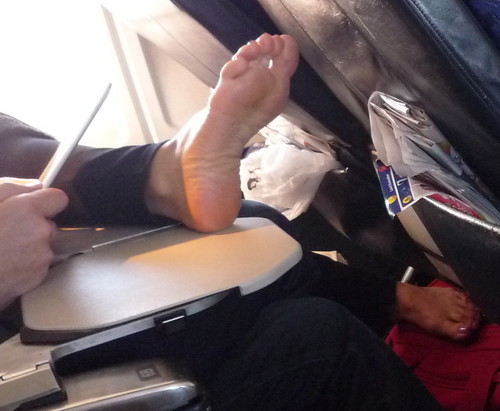

 Another aspect is how people think because they are in the bulkhead seat, they can climb their feet all over the bulkhead wall. This is the biggest peeve of mine, especially from those passengers who are in First and/or Business Class. People don't go into restaurants or their Doctor's/Lawyer's offices and put their feet up on the tables or furniture, so why do this on an airplane?
If you don't put your feet on the table at a restaurant, then why put feet on the tray-table or bulkhead (wall). I can see how some people who are tall are trying to get comfortable, however not everyone in the cabin would like to see (or smell) your feet. Would you expect your client to walk into your office or conference room and kick off their shoes and put them up on the table? How about clipping their toenails? WHY oh WHY would you want to clip them at your seat? At least go into the lavatory and clip them in the privacy....(hint: there's a trash container for the clippings when your done too!) Every airline has their share of inconsiderate passenger.


I actually put my tote bag under the seat in front of me and leave it there the entire flight. I get out what I need when I get to my seat so I don't have to bother with it later on. I do get cramped sometimes, so what I do is to get up when the seatbelt sign is off and go to the lavatory, even if I don't have to go just to stretch and get the blood flowing.


There could be times where the plane lands in terrible weather, crashes, and you have to quickly get out to save yourself, or the plane has no power and abruptly stops at the end of the runway and you hear the evacuation commands to "UNFASTEN SEATBELTS, COME THIS WAY!"

Following these simple rules not only keeps you prepared for any type of emergency, but gives you a few extra minutes doing other things while those who don't know how to follow proper jetiquette are still gathering their belongings and putting on their shoes when they had the last 25 minutes to do so.
Saturday, November 27, 2010
"Opt-Out Day" fizzles!

I can understand the inconsistencies we, as travelers, see from the TSA, however the public needs to understand that there are extremists from other countries are out to kill thousands of innocent U.S. individuals, just because we live here in the U.S..
These extreme groups don't just target the military, they target the innocent. In past wars, only those that wore the uniform of an opposing country would be targets. Now, it's a no-holes-barred. I am thankful that there haven't been any attacks over the U.S. soil, but this doesn't mean that the threat isn't there.
Many people try to say that the TSA isn't doing their jobs with these attempts, however, what these same people are forgetting, the "Shoe Bomber" and the "Underwear Bomber" originated OUTSIDE of the U.S.. Even British Airways boss rips the U.S. on our security (or lack of).


Another item that the news media fail to inform the flying public, is that the TSA Body Image Scanners do NOT store images. I can understand how the news can be misleading, allowing viewers to believe that the images view are stored, and are capable of being sold to a Third Party then your 'image' is plastered all over the internet. This statement is simply FALSE.

Tuesday, August 10, 2010
Flight Attendant Hero, or Flight Attendant Embarrassment?

After forking over more money than expected, then you have to go through the TSA security checkpoint where you can see them frisking little old grandmothers with walkers, or find them now keeping the photos from the new body image scanners, so it's only fair to understand why passengers are getting more and more frustrated before they even get to the plane.
Planes are becoming more full. No more extended leg room, cramped seats, no free food, blankets, pillows, or magazines that use to be included in the cost of the ticket. However, getting onto the plane is becoming a nightmare due to the airlines charging for the checked bags. So it's a hassle to find space for your carry-on since everyone is bringing everything onto the plane. Small bags that should be placed under the seat are being placed into the over-head, making it difficult for the last group of passengers to find space for their bags. Even some arguments that come about with stowage of items in seatback pockets. (Stowage of items in seatbacks)


Finally the plane is in the air, and the you then find out your personal TV isn't working, or the entertainment device given to you in-flight is inoperable, or the kid sitting behind you constantly kicks the back of your seat. How about that screaming child, or the overly loud and obnoxious passengers sitting across the aisle hitting on the flight attendants or buying more and more alcohol and getting drunker as the flight goes on.
Finally, you arrive at your destination and you just want to get off the plane, but now everything is happening in reverse. You are now waiting for your gate to open up and the flight has just been long and tiring and you just want to get off the plane. While the plane is sitting there, in the 'penalty box' you decide to get your bag out of the over-head bin (which you are not allowed to do because you don't know when the plane is going to move) yet, you get up to retrieve your bag. The flight attendant informs you to leave your carry-on stowed, and to remain seated as you are still on an 'active taxi-way'. Yet, you ignore the request, so the flight attendant comes to you and again asks you to take your seat, but this time, you don't like their demeanor as they have now singled you out in front of everyone and you yelled expletives at the flight attendant.

Many people see someone who has just cracked under pressure and couldn't deal with the stress, others hail him as a hero because he finally did what so many other flight attendants have wanted to do, but didn't, or is this someone who has flown under the radar far too long and should have never been given a flight attendant job.

Tuesday, June 15, 2010
More issues with Carry-On bags...
Yes, here I am talking about carry-on bags...AGAIN. If you remember, I talked about this issue with Carry-Ons could clog Holiday Travel last year. Now that airlines are charging for checked bags, passengers are starting to bring more and more bags onto the aircraft.
The only problem is, there isn't much room for the added bags. Sure, airlines have tried to expand the overhead bins to accommodate the carry-ons, however, the airlines don't have the money to keep up with the demand, and besides, many people don't listen to the many announcements from the flight crew requesting to place smaller bags under the seat in front of them, while reserving the over-head bins for the larger bags.
 On the left is what can happen when passengers actually place their small carry-ons under the seat in front of them, while reserving the bins for their roll-aboard, AND place them wheels first into the bin. There are many bags that may be too long to fit this way, but it does help to at least try. Don't worry about your handles sticking out, when the bin is closed, the bags will roll down into the bin itself, and will fit just nicely.
 Too often, I see passengers place their small purses, pocket-books, laptops, backpacks, or other small bag that can be placed under their seat, into the overhead taking up valuable room. If you have a small bag, please, just place it under the seat in front of you like this guy did on the right. I have a tote-bag that is part of my crew bag, and I always put it under the seat in front of me, not because of my computer or my In-Flight Manual being in it, but to save room for the larger bags in the bins.
After boarding is complete, and you see a bin that still has plenty of room in it, feel free to place your smaller bag into the bin, but all we ask as crew members is just be courteous to your fellow passenger and place that small bag under the seat, no matter what the duration of your flight is.
Now, don't place your bag behind your legs for take-off and/or landing. Remember, FAR 121.589 is a safety regulation that is designed to "prevent carry-on items from slowing an emergency evacuation and to prevent injury to passengers by ensuring items are properly restrained." Behind your legs is not properly restrained. Don't wrap your strap around your leg either, as this may cause you to trip during an evacuation and get trampled. Place your bag completely under the seat in front of you, making sure you have clear access to the aisle at all times.
 The same is true if you are sitting at a bulkhead seat. All carry-on items must be properly stowed for taxi-out, take-off, turbulent weather, landing, and taxi-in. Some airlines will allow those sitting at bulkheads to board first to allow you to stow all of your bags, while at others the cabin crew will often try to keep the overhead bins available for you. Just remember: for take-off and landing, since there isn't a seat to stow your bags, all bags must be in an overhead bin.
The only problem is, there isn't much room for the added bags. Sure, airlines have tried to expand the overhead bins to accommodate the carry-ons, however, the airlines don't have the money to keep up with the demand, and besides, many people don't listen to the many announcements from the flight crew requesting to place smaller bags under the seat in front of them, while reserving the over-head bins for the larger bags.


After boarding is complete, and you see a bin that still has plenty of room in it, feel free to place your smaller bag into the bin, but all we ask as crew members is just be courteous to your fellow passenger and place that small bag under the seat, no matter what the duration of your flight is.
Now, don't place your bag behind your legs for take-off and/or landing. Remember, FAR 121.589 is a safety regulation that is designed to "prevent carry-on items from slowing an emergency evacuation and to prevent injury to passengers by ensuring items are properly restrained." Behind your legs is not properly restrained. Don't wrap your strap around your leg either, as this may cause you to trip during an evacuation and get trampled. Place your bag completely under the seat in front of you, making sure you have clear access to the aisle at all times.

Wednesday, March 31, 2010
I'm sorry, but you have to wait for an agent...
It never fails that when I'm inside the terminal, checking the computer for my work information, in uniform, and a passenger walks up and starts requesting information about something I have no clue what they are talking about. Often it's about switching seats, or get a seat assignment because they are 'standing by' for a flight and haven't received a seat assignment.
 One of the things to differentiate Pilots, Flight Attendants, and actual gate agents is agents do NOT have any sort of wings, or stripes on their uniform. These are reserved for pilots and flight attendants.
Both pilots and flight attendants will often have their roller-board bags with them, and are quickly checking the status of their schedule, or looking to see what is going on for their next flight. They don't have any ability to look at a seat map of the plane and check a passenger in, or switch seats to accommodate a family of four.
 Sure, pilots may have a bit more information about a possible delay, but they usually don't know any more about seats than flight attendants do. Pilots, whether the Captain or First Officer, will have stripes on their sleeves, as well as epaulets on their shirts. Many pilots wear hats that have a lightening bolt on it (captains) or hats as shown on the left. Either way, we can't give information about Upgrades, seat-swaps, or anything like that.
The biggest customers who request info from Flight Attendants or Pilots are surprisingly the Frequent Flier. I'm always amazed because they fly so often, they know what a pilot or flight attendant uniform looks like (Wings, stripes, bags) vs. an agent who is actually stuck behind the counter being hounded by other passengers regarding their Upgrades, seat-swaps, or other questions.
 I also wonder why passenger ask the TSA what gates their flights are leaving out of when there are monitors, 99.99% of the time right at the checkpoints. I've witnessed people getting mad at the TSA because their flight wasn't listed, or shows "Final Boarding", but why get upset at the TSA? They are there to screen bags, test for explosives, and make sure that potential terrorists don't make it to your plane, not know where your gate is.

Both pilots and flight attendants will often have their roller-board bags with them, and are quickly checking the status of their schedule, or looking to see what is going on for their next flight. They don't have any ability to look at a seat map of the plane and check a passenger in, or switch seats to accommodate a family of four.

The biggest customers who request info from Flight Attendants or Pilots are surprisingly the Frequent Flier. I'm always amazed because they fly so often, they know what a pilot or flight attendant uniform looks like (Wings, stripes, bags) vs. an agent who is actually stuck behind the counter being hounded by other passengers regarding their Upgrades, seat-swaps, or other questions.

Sunday, March 7, 2010
When the seatbelt sign goes on, it doesn't mean to get up and stretch
One of the things that continues to amaze me as a cabin safety professional is how the general public does not regard the safety precautions that are in place for their own safety.
 Per Federal Aviation Regulation 121.317, Passenger information requirements, smoking prohibitions, and additional seat belt requirements states: A certificate holder may operate a nontransport category airplane type certificated after December 31, 1964, that is manufactured before December 20, 1997, if it is equipped with at least one placard that is legible to each person seated in the cabin that states “Fasten Seat Belt,” and if, during any movement on the surface, for each takeoff, for each landing, and at any other time considered necessary by the pilot in command, a crewmember orally instructs the passengers to fasten their seat belts.
I am continually amazed at how when the flight starts to get turbulent, and the crew members are having difficulty walking about the cabin performing their duties, and the captain will turn on the seatbelt sign, it never fails that at least 3-5 people will get up and stretch. They do this as if "HAHA, look at me, I can defy the seatbelt sign".
Well, here are some reports to show that one should NOT get up out of their seat while the seatbelt sign is on. (well, it is common sense isn't it?)
 People were flying around
Three people were injured due to turbulence
Seven slightly injured after Qantas plane plummets due to turbulence
26 passengers injured by turbulence on Continental plane
Flight Attendants and passengers injured due to turbulence on Air Canada
 Even when the sign is not on, you should always keep your seatbelt on because you never know when that "Clear Air Turbulence" is going to hit. It may be an extremely smooth flight, you forget that you are flying in a metal tin can and BOOM, you drop 500-1000ft in seconds without any notice.
Whenever I travel, I keep my seatbelt on just like I do while driving or riding in a car. You never know when another idiot is going to sideswipe you and you could be in a serious accident. Yet, people don't care for not only their own safety, but the safety of those around them.
Please use common sense and just remain in your seat. Remember that if you do get up and the cabin crew are strapped in their seats, it's probably a good idea to immediately take your seat. They are required to inform you that "Per the FAA, the seatbelt sign is illuminated". Don't just ignore them and do your own thing, it is not just for your safety, but to those around you as well.

I am continually amazed at how when the flight starts to get turbulent, and the crew members are having difficulty walking about the cabin performing their duties, and the captain will turn on the seatbelt sign, it never fails that at least 3-5 people will get up and stretch. They do this as if "HAHA, look at me, I can defy the seatbelt sign".
Well, here are some reports to show that one should NOT get up out of their seat while the seatbelt sign is on. (well, it is common sense isn't it?)

Three people were injured due to turbulence
Seven slightly injured after Qantas plane plummets due to turbulence
26 passengers injured by turbulence on Continental plane
Flight Attendants and passengers injured due to turbulence on Air Canada

Whenever I travel, I keep my seatbelt on just like I do while driving or riding in a car. You never know when another idiot is going to sideswipe you and you could be in a serious accident. Yet, people don't care for not only their own safety, but the safety of those around them.
Please use common sense and just remain in your seat. Remember that if you do get up and the cabin crew are strapped in their seats, it's probably a good idea to immediately take your seat. They are required to inform you that "Per the FAA, the seatbelt sign is illuminated". Don't just ignore them and do your own thing, it is not just for your safety, but to those around you as well.
Tuesday, December 8, 2009
Alcohol in the Sky

This is great to have a beverage during a lengthy delay, but do remember that Federal Air Regulations 121.575, and 91.17 state that "No certificate holder may allow any person to board any of its aircraft if that person appears to be intoxicated", as well as, "no pilot of a civil aircraft may allow a person who appears to be intoxicated or who demonstrates by manner or physical indications that the individual is under the influence of drugs (except a medical patient under proper care) to be carried in that aircraft."
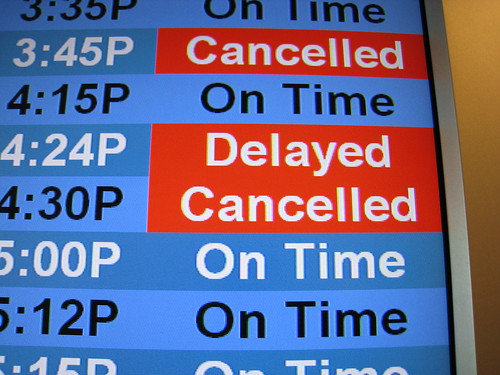
Alright, well those regulations are for restricting drunk passengers get onto the airplane, but what about while on the plane? Believe it or not, the same FARs hold true, and when a passenger gets out of hand in-flight, they could be met by law enforcement upon arrival...something you don't want to have happen!
So whose to blame if you get intoxicated while in-flight? Well, it actually comes down to the consumer. Flight Attendants aren't bar tenders, and with all the other Safety Related things they need to worry about while working, a drunk passenger shouldn't be one of them.
 One thing people need to know about alcohol and flying, is it affects your body differently in the plane, than it does while on the ground. The cabin altitude is generally set between 5,000 and 7,000 feet-meaning that there’s less oxygen to breathe. While your blood alcohol level remains the same as it would be at sea level, it feels as if you’ve drunk a lot more. Never mind that the cabin humidity is often less than 10 percent, and that alcohol dehydrates you.
Over the years, there have been many issues where you may have heard about intoxicated passengers:

I'm not saying that you shouldn't drink...by all means, DRINK, just drink moderately. Do remember that the altitude will affect your body differently than you would be at sea level, so be careful. Just because you normally drink 5 beverages at the bar, doesn't mean you can actually handle 5 beverages in the air. A plane is not a bar. If someone drinks too much at their favorite tavern, they can push that person out the door and call him a cab. Try doing that at 30,000 feet.
 If your drink gets low, don't ever say “Hey, stewardess!” The term “stewardess” and “steward” are widely considered to be archaic, if not derogatory. They are especially offensive if they’re used while, at the same time, you repeatedly press the flight attendant “call” button over your seat. Flight attendants are not airborne waiters. They are bona fide crew members who have undergone many hours of safety training. Yeah, they serve drinks but if the plane goes down, they can also save your butt.
To quote a selection from Christopher Elliott's page which highlight some idea's about alcohol on flights.
1. Alcohol heightens a stressful experience.
Unless you haven’t flown in a few years, you probably know that air travel is getting more stressful. Alcohol can make it worse, say experts. “Drinking on planes has unique hazards, particularly as flying becomes more stressful,” says Karen Sternheimer, a sociologist who teaches at the University of Southern California. “If there is a long delay on the tarmac the irritation can be magnified by alcohol.” At a bare minimum, passengers need to be sober enough to understand and cooperate with crew instructions. “Under increasingly stressful conditions, too much alcohol can make a simple annoyance into a serious problem,” she adds.
2. There’s nowhere to run.
Anywhere else, you can walk away from an unruly drunk. But not on a plane. “It’s a metal tube and blasting off at hundreds of miles per hour,” says Jeffrey Lord, a veteran frequent flier based in Burlington, Vt. (Lord believes alcohol isn’t the only problem on a plane. “How about spending hours strapped in with these stressed-out companions with nothing other than caffeinated beverages being served?” he asks. Good point.)
3. Drinks on a plane aren’t just intoxicating — they’re toxic.
“Higher altitudes do amplify the affect of alcohol, which, as you can imagine, can cause problems for passengers that imbibe too much,” says Ashley Halsey, a spokeswoman for American Behavioral, a healthcare organization that specializes in drug and alcohol abuse and treatment for employers. “Because alcohol impairs judgment, the likelihood of violent or other anti-social behavior is increased. When people fly, they also get dehydrated, and alcoholics tend to drink alcohol instead of water, which tends to increase their adverse reaction.”
4. It’s annoying.
Just listen to Terry Ward’s account of her last flight from Orlando to Newark. “I sat next to a group of guys who were on their way to Montreal for a boys’ weekend,” she remembers. “They started drinking right after we took off and didn’t stop. Hard liquor the whole flight.
I thought the flight attendants would stop serving them but they didn’t, because one of the guys was tipping them $20 each round.” Instead of cutting off the passengers, she made all of their drinks doubles, as they requested. “It was completely obnoxious,” she adds.
5. It’s embarrassing, too.
Who doesn’t have a story to tell about having one too many on a plane? Here’s Denise Vardakas’. She and her mother were flying from San Diego to Grand Cayman, and on their final leg they enjoyed “endless Jack and Diet Cokes.” She adds, “We were having a great time chatting with the crew members, and a few of our fellow passengers.” On their way back a week later, the same crewmembers greeted them as the “Jack and Diet” ladies. Oh, my.
6. You could relapse.
If you’re off the booze, a plane trip is a relapse waiting to happen, say experts. “I’m still constantly surprised by how many of my patients will relapse or overdrink on planes,” says Carrie Wilkens, the co-founder and clinical director of the Center for Motivation & Change, a private group practice in New York that specializes in treating addiction and compulsive behaviors.
“It’s gotten to the point where I’ve heard it as a therapist so regularly that now, when any one of my clients is planning a trip, I tell them, ‘OK, we have to make up a plan for how you’re going to manage this flight.’” Her patients inevitably agree that they drink more in the air, and take precautions to avoid it.
7. How are you getting home?
Even if you survive your flight without incident, there remains the issue of getting back home. If you’re planning to drive, you might keep the case of Dana Papst in mind. A few years ago, after disembarking from a US Airways flight on which he was served alcohol, he crashed his car, killing himself and five others. The FAA later cleared the airline of any wrongdoing.
I don’t consider myself a modern-day prohibitionist, but I think these practical reasons for keeping the skies alcohol-free make sense.
Why not wait until you’re home to crack open a bottle? It could make your next flight a better one — if not save your life.
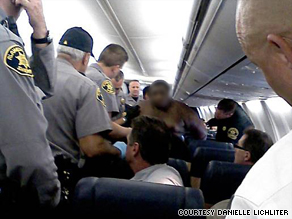


 As on the ground, if you must drink in-flight, please drink responsibly and know when you are starting to get tipsy. Don't leave it up to the Flight Crew to put a stop to your enjoyment. Be sure to drink plenty of water, more than you normally would while at a regular bar on the ground.
 Wednesday, November 25, 2009
The Holidays have officially started

 Despite all of the different travel delays over the last year (and to come before year end) I hope that everyone will stop to remember that a good portion of the delays were not the fault of the individual flight crews. In-flight crew members are the ones that you may see the most, but remember that those long delays sitting on the tarmac are because of the antiquated Air Traffic Control systems. Something that your Flight Attendants and Pilots can NOT control.
When it snows, many things have to happen on top of the normal operation of getting your plane to the runway.

Snow has to be removed from the gate area in order for the plane to see the center taxi line so it doesn't taxi off of the taxi-ways.
Just like the roads and highways, special snow-removal trucks go out to clear the snow and ice on the taxi-ways, as well as the runways, to ensure these are clear for the planes.

 If it's close to freezing and raining, sleeting, or snowing, then your plane may have to be de-iced, especially from ice and snow. Some airlines have a system where you taxi to a specific location set up by the airport to get de-iced, but you are still being de-iced in order of your take-off slot. Some airlines will de-ice your plane at the gate.
Both instances are done with the engines turned off. This prevents any fluid getting into the air that you breathe on the planes. Special trucks will quickly go around the plane to remove as much snow and ice as possible. Once this is done, you may smell a slight odor upon engine start, but that's normal.
Hopefully there won't be too many delays this upcoming winter season, but do take a second and ask yourself how you got to the airport and what the conditions were like. Don't take the frustrations of delays out on the innocent flight crews, they want to get you to your destination as much as you want to get to your destination.
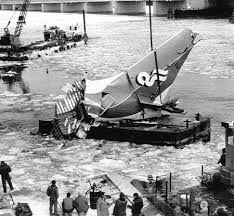 Have a specific cruise that you need to get to? Some cruise lines will give you an estimated time from your flight arrival to the ship, but remember that that's on a good day. If you have a cruise and it's snowing at your departure city, there is nothing the airlines can do because the ship left without you. Always remember that the reason for your delay is for your safety, snow has to be removed in order for the plane to take off. You can't rush weather delays, especially snow delays. All we have to do is remember back to January of 1982 the Air Florida crash into the 14th Street Bridge in Washington, DC and plunged into the icy Potomac River.
 Despite some improper de-icing procedures that American Airlines had at Washington National Airport at the time, it was freezing and snowing, the crew did not activate the engine anti-ice system. Analysis of the cockpit voice recorder determined that, during the departure checklist, the copilot announced, the pilot confirmed, that the plane's own engine anti-icing system was turned off. This system uses heat from the engines to prevent sensors from freezing and providing inaccurate readings.
Adding to the plane's troubles was the pilots' decision to maneuver closely behind a DC-9 that was taxiing just ahead of the Air Florida aircraft prior to takeoff, due to their mistaken belief that the warmth from the DC-9's engines would melt the snow and ice that had accumulated on Flight 90's wings. This action — which went specifically against flight manual recommendations for an icing situation — actually contributed to additional icing on the 737. By sitting behind the preceding aircraft, the exhaust gases melted the snow on the wings. During take off, instead of falling off the plane, this slush mixture then froze on the wings' leading edges and the engine inlet nose cone.

When you sit down for dinner during the holidays after a flight, stop and be sure to be Thankful of the miraculous feats that got you there, even if you did get there late.
Subscribe to:
Posts (Atom)