Friday, December 25, 2009

Tuesday, December 8, 2009
Alcohol in the Sky

This is great to have a beverage during a lengthy delay, but do remember that Federal Air Regulations 121.575, and 91.17 state that "No certificate holder may allow any person to board any of its aircraft if that person appears to be intoxicated", as well as, "no pilot of a civil aircraft may allow a person who appears to be intoxicated or who demonstrates by manner or physical indications that the individual is under the influence of drugs (except a medical patient under proper care) to be carried in that aircraft."
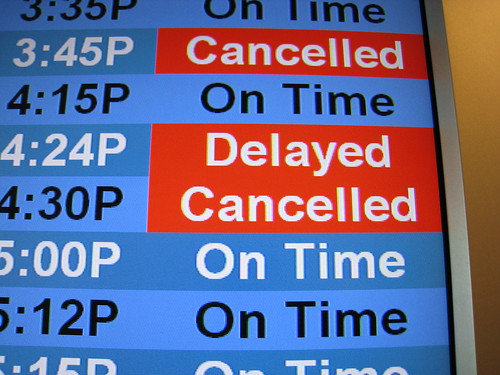
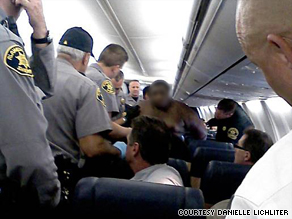
Alright, well those regulations are for restricting drunk passengers get onto the airplane, but what about while on the plane? Believe it or not, the same FARs hold true, and when a passenger gets out of hand in-flight, they could be met by law enforcement upon arrival...something you don't want to have happen!
So whose to blame if you get intoxicated while in-flight? Well, it actually comes down to the consumer. Flight Attendants aren't bar tenders, and with all the other Safety Related things they need to worry about while working, a drunk passenger shouldn't be one of them.
 One thing people need to know about alcohol and flying, is it affects your body differently in the plane, than it does while on the ground. The cabin altitude is generally set between 5,000 and 7,000 feet-meaning that there’s less oxygen to breathe. While your blood alcohol level remains the same as it would be at sea level, it feels as if you’ve drunk a lot more. Never mind that the cabin humidity is often less than 10 percent, and that alcohol dehydrates you.
Over the years, there have been many issues where you may have heard about intoxicated passengers:

I'm not saying that you shouldn't drink...by all means, DRINK, just drink moderately. Do remember that the altitude will affect your body differently than you would be at sea level, so be careful. Just because you normally drink 5 beverages at the bar, doesn't mean you can actually handle 5 beverages in the air. A plane is not a bar. If someone drinks too much at their favorite tavern, they can push that person out the door and call him a cab. Try doing that at 30,000 feet.
 If your drink gets low, don't ever say “Hey, stewardess!” The term “stewardess” and “steward” are widely considered to be archaic, if not derogatory. They are especially offensive if they’re used while, at the same time, you repeatedly press the flight attendant “call” button over your seat. Flight attendants are not airborne waiters. They are bona fide crew members who have undergone many hours of safety training. Yeah, they serve drinks but if the plane goes down, they can also save your butt.
To quote a selection from Christopher Elliott's page which highlight some idea's about alcohol on flights.
1. Alcohol heightens a stressful experience.
Unless you haven’t flown in a few years, you probably know that air travel is getting more stressful. Alcohol can make it worse, say experts. “Drinking on planes has unique hazards, particularly as flying becomes more stressful,” says Karen Sternheimer, a sociologist who teaches at the University of Southern California. “If there is a long delay on the tarmac the irritation can be magnified by alcohol.” At a bare minimum, passengers need to be sober enough to understand and cooperate with crew instructions. “Under increasingly stressful conditions, too much alcohol can make a simple annoyance into a serious problem,” she adds.
2. There’s nowhere to run.
Anywhere else, you can walk away from an unruly drunk. But not on a plane. “It’s a metal tube and blasting off at hundreds of miles per hour,” says Jeffrey Lord, a veteran frequent flier based in Burlington, Vt. (Lord believes alcohol isn’t the only problem on a plane. “How about spending hours strapped in with these stressed-out companions with nothing other than caffeinated beverages being served?” he asks. Good point.)
3. Drinks on a plane aren’t just intoxicating — they’re toxic.
“Higher altitudes do amplify the affect of alcohol, which, as you can imagine, can cause problems for passengers that imbibe too much,” says Ashley Halsey, a spokeswoman for American Behavioral, a healthcare organization that specializes in drug and alcohol abuse and treatment for employers. “Because alcohol impairs judgment, the likelihood of violent or other anti-social behavior is increased. When people fly, they also get dehydrated, and alcoholics tend to drink alcohol instead of water, which tends to increase their adverse reaction.”
4. It’s annoying.
Just listen to Terry Ward’s account of her last flight from Orlando to Newark. “I sat next to a group of guys who were on their way to Montreal for a boys’ weekend,” she remembers. “They started drinking right after we took off and didn’t stop. Hard liquor the whole flight.
I thought the flight attendants would stop serving them but they didn’t, because one of the guys was tipping them $20 each round.” Instead of cutting off the passengers, she made all of their drinks doubles, as they requested. “It was completely obnoxious,” she adds.
5. It’s embarrassing, too.
Who doesn’t have a story to tell about having one too many on a plane? Here’s Denise Vardakas’. She and her mother were flying from San Diego to Grand Cayman, and on their final leg they enjoyed “endless Jack and Diet Cokes.” She adds, “We were having a great time chatting with the crew members, and a few of our fellow passengers.” On their way back a week later, the same crewmembers greeted them as the “Jack and Diet” ladies. Oh, my.
6. You could relapse.
If you’re off the booze, a plane trip is a relapse waiting to happen, say experts. “I’m still constantly surprised by how many of my patients will relapse or overdrink on planes,” says Carrie Wilkens, the co-founder and clinical director of the Center for Motivation & Change, a private group practice in New York that specializes in treating addiction and compulsive behaviors.
“It’s gotten to the point where I’ve heard it as a therapist so regularly that now, when any one of my clients is planning a trip, I tell them, ‘OK, we have to make up a plan for how you’re going to manage this flight.’” Her patients inevitably agree that they drink more in the air, and take precautions to avoid it.
7. How are you getting home?
Even if you survive your flight without incident, there remains the issue of getting back home. If you’re planning to drive, you might keep the case of Dana Papst in mind. A few years ago, after disembarking from a US Airways flight on which he was served alcohol, he crashed his car, killing himself and five others. The FAA later cleared the airline of any wrongdoing.
I don’t consider myself a modern-day prohibitionist, but I think these practical reasons for keeping the skies alcohol-free make sense.
Why not wait until you’re home to crack open a bottle? It could make your next flight a better one — if not save your life.


 As on the ground, if you must drink in-flight, please drink responsibly and know when you are starting to get tipsy. Don't leave it up to the Flight Crew to put a stop to your enjoyment. Be sure to drink plenty of water, more than you normally would while at a regular bar on the ground.
 Wednesday, November 25, 2009
The Holidays have officially started

 Despite all of the different travel delays over the last year (and to come before year end) I hope that everyone will stop to remember that a good portion of the delays were not the fault of the individual flight crews. In-flight crew members are the ones that you may see the most, but remember that those long delays sitting on the tarmac are because of the antiquated Air Traffic Control systems. Something that your Flight Attendants and Pilots can NOT control.
When it snows, many things have to happen on top of the normal operation of getting your plane to the runway.

Snow has to be removed from the gate area in order for the plane to see the center taxi line so it doesn't taxi off of the taxi-ways.
Just like the roads and highways, special snow-removal trucks go out to clear the snow and ice on the taxi-ways, as well as the runways, to ensure these are clear for the planes.

 If it's close to freezing and raining, sleeting, or snowing, then your plane may have to be de-iced, especially from ice and snow. Some airlines have a system where you taxi to a specific location set up by the airport to get de-iced, but you are still being de-iced in order of your take-off slot. Some airlines will de-ice your plane at the gate.
Both instances are done with the engines turned off. This prevents any fluid getting into the air that you breathe on the planes. Special trucks will quickly go around the plane to remove as much snow and ice as possible. Once this is done, you may smell a slight odor upon engine start, but that's normal.
Hopefully there won't be too many delays this upcoming winter season, but do take a second and ask yourself how you got to the airport and what the conditions were like. Don't take the frustrations of delays out on the innocent flight crews, they want to get you to your destination as much as you want to get to your destination.
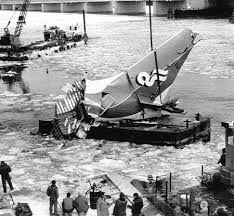 Have a specific cruise that you need to get to? Some cruise lines will give you an estimated time from your flight arrival to the ship, but remember that that's on a good day. If you have a cruise and it's snowing at your departure city, there is nothing the airlines can do because the ship left without you. Always remember that the reason for your delay is for your safety, snow has to be removed in order for the plane to take off. You can't rush weather delays, especially snow delays. All we have to do is remember back to January of 1982 the Air Florida crash into the 14th Street Bridge in Washington, DC and plunged into the icy Potomac River.
 Despite some improper de-icing procedures that American Airlines had at Washington National Airport at the time, it was freezing and snowing, the crew did not activate the engine anti-ice system. Analysis of the cockpit voice recorder determined that, during the departure checklist, the copilot announced, the pilot confirmed, that the plane's own engine anti-icing system was turned off. This system uses heat from the engines to prevent sensors from freezing and providing inaccurate readings.
Adding to the plane's troubles was the pilots' decision to maneuver closely behind a DC-9 that was taxiing just ahead of the Air Florida aircraft prior to takeoff, due to their mistaken belief that the warmth from the DC-9's engines would melt the snow and ice that had accumulated on Flight 90's wings. This action — which went specifically against flight manual recommendations for an icing situation — actually contributed to additional icing on the 737. By sitting behind the preceding aircraft, the exhaust gases melted the snow on the wings. During take off, instead of falling off the plane, this slush mixture then froze on the wings' leading edges and the engine inlet nose cone.

When you sit down for dinner during the holidays after a flight, stop and be sure to be Thankful of the miraculous feats that got you there, even if you did get there late.
Saturday, November 21, 2009
Stowage of Items in Seat Backs

The Flying Pinto did some thorough digging, and got some guidance about the policy for airlines by the FAA, but it wasn't until just recently that we would have a more defined guideline on the info about what can or can not be placed in that seat back pocket.
Here is clarification on Seat back pocket for everyone to better understand.
U.S. Department of Transportation
Federal Aviation Administration
InFO Information for Operators
InFO 09018
DATE: 11/12/09
Flight Standards Service
Washington, DC
An InFO contains valuable information for (clip)... impact on safety.
Subject: Stowage of Items in Seat Pockets
Purpose: To clarify guidance for air carriers about the stowage of items in seat pockets.
Discussion: Existing Federal Aviation Administration (FAA) policy in FAA Order 8900.1, Volume 3, Chapter 33, Section 6, part 3-3547. CARRY-ON BAGGAGE, Section F #5, Operations—Cabin Safety, states that carry-on baggage programs should...
Define properly stowed, to include overhead bin stowage and under seat stowage. For proper under seat stowage of carry-on baggage, there must be forward and side restraints to prevent bags from sliding into the aisle.
Prohibit the stowage of carry-on baggage and other items in the lavatories and seat back pockets (the only items allowed in seat back pockets should be magazines and passenger information cards)...
The intent of the carry-on baggage regulation, [I]Title 14 of the Code of Federal Regulations (14 CFR) part 121, § 121.589, is to prevent carry-on items from slowing an emergency evacuation and to prevent injury to passengers by ensuring items are properly restrained. Seat pockets have been designed to restrain approximately 3 pounds of weight and not the weight of additional carry-on items. Seat pockets are not listed in the regulation as an approved stowage location for carry-on baggage. If a seat pocket fails to restrain its contents, the contents of the seat pocket may impede emergency evacuation or may strike and injure a passenger.
If small, lightweight items, such as eyeglasses or a cell phone, can be placed in the seat pocket without exceeding the total designed weight limitation of the seat pocket or so that the seat pocket does not block anyone from evacuating the row of seats, it may be safe to do so.
The requirements of the carry-on baggage regulation are applicable to take-off and landing. Nothing in the carry-on baggage regulation prohibits a passenger from taking out small personal items from an approved stowage location and placing them in the seat pocket after takeoff and stowing them in approved locations prior to landing. Crewmembers may still direct a passenger to stow carry-on items in an approved stowage location, during flight should they pose a hazard, such as in the case of turbulence.Hopefully this helps in some of the confusion that many of us had previously. I know that some airlines are more strict on this policy than others, as well as some flight attendants being more strict than others, however, this is the official guidance made just this month on what can, or can't, be placed in seat back pockets.
(clip)
Happy flying and btw, don't put your laptop in the seat back pockets!
Friday, November 20, 2009
2010 Drum Corps International Tour Schedule

It truly feels that it was just yesterday when I saw my only 2009 show in Stillwater, MN. It was all over before I knew it. Now, it's starting all over again with annual banquets, auditions, and instructional camps one weekend a month until move-in, usually around Memorial Day weekend.
Drum Corps International today announced the schedule for the 2010 DCI tour. I'm extremely happy, no, ecstatic, to see that DCI will be here in Minnesota not just for their normal Stillwater and Mankato shows, but also a new show at the University of Minnesota's TCF Bank Stadium.

I am so excited for this show as it will be the first biggest show with 24 corps that I have seen in a long time. (actually since I was volunteering with The Cavaliers in 2003) I may not be able to watch the first show on June 27th in Stillwater (which is a great location for a show) because it is Twin Cities Pride weekend here in Minneapolis, but you can bet your sweet bippy that I will be inside the TCF Band Stadium to witness a great night of drum corps!
New events, new locations, new venues and the unprecedented excitement that only the corps of Marching Music’s Major League can deliver are all on schedule for another spectacular summer! The 2010 Drum Corps International Tour will be comprised of an impressive lineup of 113 events in 39 states taking place over a 58-day span from June through August.So be sure to check out DCI's website to see if there is a Drum Corps show in your city!
Passenger Airport Security Experience by: Flying with Fish
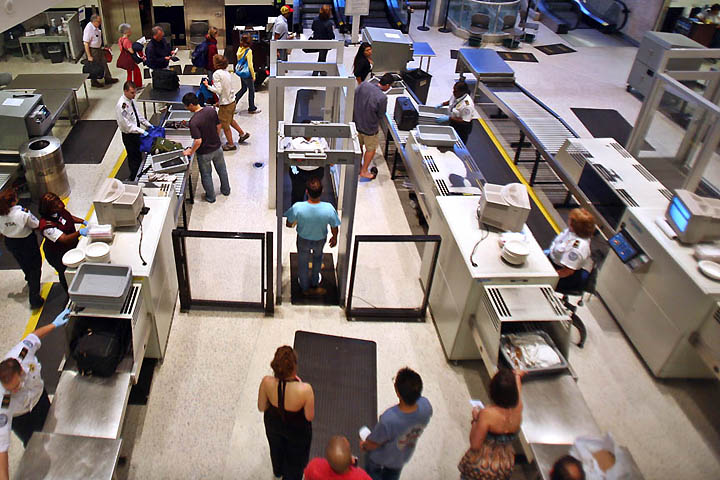
I thought it would be good to not only highlight his blog, but post it here to give you a good reminder and advice on getting through the TSA Security checkpoints quickly.
Fish writes:
Over the past few days I have been writing about airport security and traveller personal security. Over the course of these few posts I have been revisiting important topics I think every traveller should know to make their experience easier, smoother, less stressful and overall safer for them on the road.
It has been quite a while since I discussed the anatomy of the airport security screening process. So while summer travel hits its peak period in the Northern Hemisphere, I thought now was a good time to revisit this topic.
Of all the e-mails I receive, airport security and the whole process of airport security tops the list of questions, comments and complaints. Maybe it is just that I am in tune with how airport security works that it does not phase me, but I know the whole process is confusing and frustrating to millions of air travellers around the world.
So…without further ado…I present to you, The Passenger Airport Security Screening Experience…From Start To Finish. This security process is virtually identical around the world.
1) The Line Up — The Line Up is simple. It is where passengers begin to line up to enter the security-screening checkpoint. You only enter the security-screening checkpoint once you have your boarding pass (I have seen people get all the way through the security line only to be turned away because they forgot to pick up their boarding pass).
2) The ID Checker — This is the security person at the ‘entrance’ to the actual screening process. This person inspects your photo identification (usually a passport or drivers license) and your travel documents to make sure your name/face match those on your boarding pass.
3) The Barker — ‘The Barker’ is the security person who walks up and down the line ‘barking’ that you should have your boarding pass and valid photo identification out and available for inspection, that your laptop should be out of your bag for x-ray inspection and that you are only entitled to only pass through security with no more than 3oz of liquids in each container (you may actually have 3.4oz), these containers must be in one single 1-quart bag and only one bag per person (hence ‘3-1-1′ bag). “The Barker” may also split a single line into two lines, ask to see you boarding pass and at times just intimidate inexperienced travelers.
4) The Long Table — The actual x-ray and metal detector process usually begins with a long table with plastic bins. This is where you remove your shoes (if required, the TSA does require it everywhere though); your laptop (if required); your 3-1-1 bag (now
virtually universal at all security worldwide). You also want to start making sure you have no metal on you, this means place your coins, keys, mobile phone, etc in a secure pocket, or inside one of your bags.
5) The Bins — Every ‘Long Table’ has ‘The Bins.’ ‘The Bins’ are where you’ll place your jacket, laptop and other lose items. Some airports require shoes go in a bin, others do not. When it doubt, toss them in a bin.
6) The X-Ray Scanner — At the end of the ‘Long Table” is the X-Ray Scanner and its conveyor belt. You want to place your bags and bins in the X-Ray scanner. Remember that bins go in vertically NOT horizontally. Make sure you witness your bags entering the X-Ray scanner before proceeding to the next step, and from that moment never take your eyes off the ‘exit’ of the x-ray scanner! Also remember to keep your boarding pass out and in your hand, do not place that through with your bags and bins.
7) The Metal Detector — Once your bags and bins are in the x-ray scanner (and your boarding pass is in your hand!) you’ll line up for the metal detector. Always wait outside the metal detector until the security personnel have motioned for you to pass through the metal detector. Before passing through pat yourself down to check for any metal items you may have missed. If you have any loose metal items declare them before you go through the metal detector.
7a) The Metal Detector Wand (if you set off the alarm)– ‘The Wand’ is a simple hand held metal detector used by security personnel to check passengers who have set off the metal detector multiple times. You are usually hold your arms out and are ‘traced’ with the wand to find the source of the metal.
8 ) The Rollout — ‘The Roll-Out’ is the end of the X-Ray scanner where you retrieve your bags-n-bins. Pay attention that you have all your items and that they have exited the x-ray scanner before walking off. Take your items methodically from the x-ray scanner and if you must ‘put yourself back together’ do so at the chair or benches away from the x-ray scanner. By moving away from the x-ray scanner you’re not only allowing other
passengers to proceed through, but you’re also moving to a calmer environment to put your shoes on, put your laptop away, put your 3-1-1 bag away and retrieve the small metal items you have placed in a pocket or a bag.
9) The Bag Check (**NOT EVERYONE GETS A BAG CHECK**) — There seem to be few words dreaded more than hearing “BAG CHECK LANE 7″ (or whatever lane you’re in) for many passengers. Honestly, I know what my carry on bags look like and I’m personally often more concerned when I don’t here this being yelled out while the x-ray security operator is viewing my bag. A bag check is really simple. You collect all your items, just as discussed in “8 ) The Rollout” and a security screener carries one of your bags, in your full view, to a separate table. At that table you must never touch your items unless instructed to do so, the screener will look through tour bag and possibly wipe it down with a swab intended to detect explosives. This is not a big deal; when they are done you repack your bag (unless you have explosives in which case you have a lot of explaining to do and you’ll be greeted by law enforcement shortly).
10) Have A Good Flight — Make sure you have all of your possessions and head off into the terminal to have a good flight.
Above is a photo of the TSA security screening process at JFK Airport’s Terminal 7.This, and other great information, can be found on Fish's website: The Passenger Airport Screening Experience. Flying with Fish
Happy Flying!
Thursday, November 19, 2009
Why don't airlines allow cell phone use when aircraft door is closed?
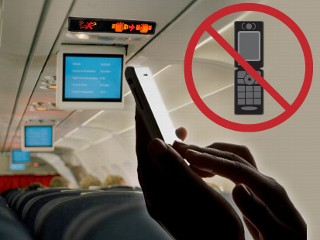
Flight Attendants have to make sure that the aircraft cabin is ready for departure. Before they can inform the Captain that it's ready, all regulations that the airline must follow per the Federal Aviation Administration need to be in place, which brings us to Portable Electronic Devices.
Per FAA Title 14, Part 91.21, and Part 121.306,"Portable Electronic Devices" "no person may operate, nor may any operator or pilot in command of an aircraft allow the operation of, any portable electronic device on any of the following U.S.-registered civil aircraft:But the question remains, why do flight attendants get so frustrated, mad, or go 'postal' (for lack of a better word) when a passenger ignores them when asked to turn off the device? It's quite simple; If the passenger can't follow a simple rule while on the ground, then what's going to happen once they are in the air? Can't you just turn off your device for 10-30 minutes until it's ok to turn on your device back on?
(1) Aircraft operated by a holder of an air carrier operating certificate or an operating certificate; or
(2) Any other aircraft while it is operated under IFR"
ABCnews.com did a great article back in February asking this same question. Why Can't we use Cell Phones on Planes? by KI MAE HEUSSNER. The article highlights that "contrary to what most passengers think, it's the FCC – not the FAA – that implemented the cell phone ban in the first place". The article goes on describing "That before an airline could allow cell phone use in-flight, it would have to prove to the FAA that it wouldn't interfere with the airplane systems." But the FAA says the point is moot.
"As far as the wireless system goes, the final authority rests with the FCC," Les Dorr, an FAA spokesman told ABCNews.com. Since 1991, the FCC has banned the use of cell phones on airplanes because of potential interference with ground networks.
20/20 did an interview to see if Cell Phones are Dangerous in Flight: Myth of Fact. Whether it's proven that there is little to no interference from one cell phone, or one electronic device, why take the risk into your own hands? Even though there isn't proof that a cell phone can bring down a plane, until the FAA and the FCC say using cell phones in flight is safe, it's probably best to just keep those gadgets off.
There is also a good video back in 2006 about Phone Safety in the Sky with Scott McCartney who writes "The Middle Seat" column with the Wall Street Journal.
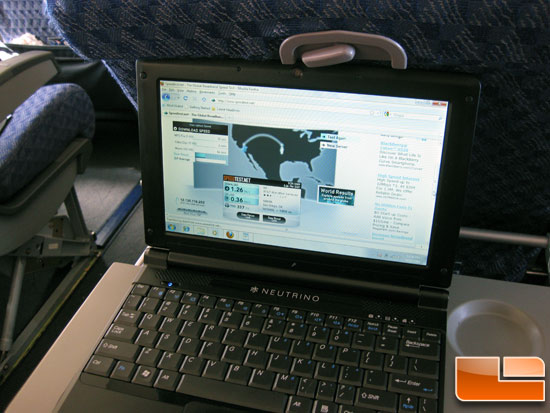

The biggest difference between these two is cell phones continuously search for a tower. As of right now, planes do not have any antenna's for such use, so it's great to not have to listen to that business person screaming to finalize his/her deal. This way, they can do it quietly on the internet!
It's always better to turn off your device for those few minutes. One, no matter if it's your first time flying, or your 2millionth, it's always best to stop what you are doing, and watch the flight attendants do their safety demo, (or watch the video). That safety announcement is 100x more important than that text on your phone. Remember, it was less than 6minutes after take-off when USAirways flight 1549 had to ditch into the Hudson back in January.
Just remember to follow your flight attendants instructions though. Per FAA title 14, Part 91.11: "No person may assault, threaten, intimidate, or interfere with a crewmember in the performance of the crewmember's duties aboard an aircraft being operated" An incident report may be filed with the appropriate federal agency if you do. The Federal Aviation Act provides for fines of up to $10,000. In the case of interference with a crew member in the performance of crew duties, imprisonment for up to twenty years may be imposed in addition to the fine.
Subscribe to:
Posts (Atom)